Showing posts with label development. Show all posts

Saturday, June 28, 2014

A New Technique for Teaching Kids Colors

 
The names of colors are one of the first things that kids learn - but it is also one of the things that kids struggle with the most. 

My mom introduced me to a great article (called "Why Johnny Can't Name His Colors" by Melody Dye) about teaching kids the names of colors and why it can be so difficult. It describes a study in which 2 and 3 year olds were tested on their colors and many failed. Their parents were worried that they were colorblind!


Prenominal versus Postnominal 
The problem is in the way that English-speakers talk. You may already know that English is one of the more difficult languages to learn (we have many rules that often contradict each other - "i before e except after c"... but there are lots of weird words. Like that one). The English color names can be especially difficult to learn because we use color names prenominally - meaning "before nouns." (Look at the green grass, the black dog, the yellow banana, etc).

Without going into to much detail (if you're interested in all of the mechanics and the study itself, check out the original article - it's a good read!), children can learn their color names faster and more easily if you use the color names postnominally (after the noun).

"When you stick the noun before the color word, you can successfully narrow their focus to whatever it is you’re talking about before you hit them with the color. Say “the balloon is red,” for example, and you will have helped to narrow “red-ness” to being an attribute of the balloon, and not some general property of the world at large. This helps kids discern what about the balloon makes it red."

The researchers then took a group of kids and had them go through some postnominal color name training (they would show them something, like a crayon, and say, "this crayon is blue"). The kids that had that training improved significantly!


What You Can Do
To help your 2- or 3-year-old learn their color names, just change the way you talk about objects. After reading this article - before my son was even born - I started adjusting the way I talked. It was awkward at first, but I wanted to get in the habit of describing things in the best way to help my boy learn. When I read books to him, after reading the page the way it's written (orange tiger), I'll then say the color and object again, but change the structure to the new way ("that tiger is orange").


Books About Colors
Which brings me to a disappointing fact: most books use color names the traditional way (red apple, yellow sun, etc). Even some of my favorites! (Brown Bear, Brown Bear, What Do You See?, and One Fish, Two Fish, Red Fish, Blue Fish, for example). But thanks to the blog Youth Lit Reviews, I was able to find a few titles that use color names in the new way ("the apple is red," "the sun is yellow")!

A Color of His Own by Leo Lionni


Lemons Are Not Red by Laura Vaccaro Seeger


If you know of any others, or find any others that use color names postnominally, please comment below to let me know! I love to collect books (to my husband's dismay - they're taking over our apartment!) and would love to get my hands on some books that use this new technique of teaching colors.

But for now, I will continue to read the books I already have, and will just start a conversation (yes, with my 3-month-old!) about the color on the page. "Red apple. See that, baby? The apple is red!"

UPDATE 01/16/2015

I have discovered a few more books that use color names postnominally (or, "the right way" as I usually refer to it with my family. Though there is really no right or wrong way, they've only just discovered that one way may be more effective than the other).

Baby Bear Sees Blue by Ashley Wolff
A beautiful picture book about a baby bear venturing out into the world and seeing lots of colors. "'Those are the strawberries,' Mama says. Baby bear sees red." "'That is a butterfly,' Mama says. Baby bear sees orange." Etc.

Oh My Oh My Oh Dinosaurs by Sandra Boynton
This book is really cute - not specifically about colors, but it's a rhyming book about dinosaurs. In addition to dinosaurs being cute and spiny and mean, one page also says there are "Dinosaurs Red, Blue, Yellow, and Green."

Winnie-the-Pooh's Colors inspired by A.A. Milne
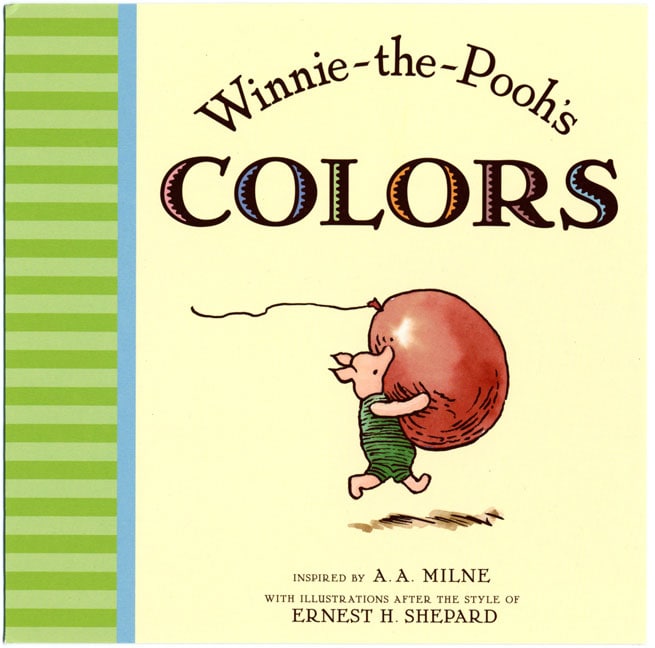
This board book has both prenominal and postnominal colors - one page says "Piglet wears a green sweater" and another page says "Tigger is orange."

UPDATE 01/20/2015

I found two more books! I'm quite excited that this list has grown, since I was a little dismayed by the choices I'd originally found (that use colors postnominally).


Another dinosaur book: How Do Dinosaurs Count to Ten by Jane Yolen & Mark Teague

Actually a book about counting to ten (duh), one page does use color names postnominally.
The toy trucks are painted blue, green, and red (they are not "blue, green, and red trucks").

I love Tad Hill's Duck & Goose books, and am really glad to see that the color book uses the colors the "right" way.
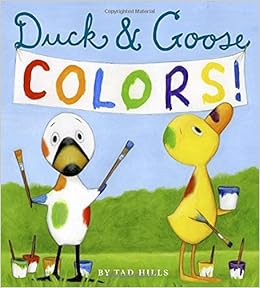
This entire book appears to be "correct." (I do not yet own it). The sample shows pages that say "The inchworm is green, like leaves." and, "Duck is yellow, like a field of buttercups."

Share this Post Share to Facebook Share to Twitter Email This Pin This

Saturday, June 21, 2014

Does My Baby Miss Me? Separation Anxiety and Object Permanence


Does my baby miss me?
I was asking myself this question while I was at dinner with my husband for our first date night since our son was born. I told myself that he probably didn't realize I was gone - he was too young. But when I got home he was crying really hard and apparently had been for most of the time we were gone. As soon as I took him in my arms, he quieted, and just whimpered for a while before falling asleep minutes after the sitter left. I began wondering if he had missed me/us, or if it was something else. (Perhaps he was teething? I also mused.) So I decided to see if it was possible for him to realize we were gone and be sad from our absence at such a young age (3 months).


From what I found, it seems that most babies do not get separation anxiety until they are at least 6 months old. At around that age, babies develop what is called object permanence, which means that they can remember people and things that aren't visible or present. (Which is why 6-month-old babies get a kick out of "peek-a-boo" but younger babies do not). Before object permanence develops, when an item isn't visible, it just doesn't exist to them. They can't remember that they were playing with their toy giraffe only minutes before; if they aren't looking at it, they aren't thinking about it. For babies under 6 months of age, they literally practice "out of sight, out of mind."
 
Before object permanence develops, his toy giraffe only exists when it's visible to him.


How do I know when my baby has developed object permanence?
First signs of the development of object permanence can be seen when your baby looks around for an object that he dropped or that you took away.


How long does separation anxiety last?
During the second half of baby's first year (months 6-12) is the first peak of separation anxiety. There is another peak during the second half of the second year (months 18-24), though some babies experience them back-to-back for about an 8-month stretch of separation anxiety.

Not all babies will experience bad separation anxiety, though most babies will have at least one bout of it as part of a healthy development. Some babies and toddlers can experience debilitating separation anxiety and develop Separation Anxiety Disorder. But there are steps you can take to make separations less stressful for you and for your little one - but I won't go into those now.

As sweet as it was to think my boy missed me (even though it was heartbreaking hearing him cry like that), I don't think that's what it was. He's a pretty advanced little boy - rolled over for the first time before he was even 2 months old (though he didn't repeat it until he was 3 months), can hold his own weight on his legs (but can't balance enough to stand unsupported), and can almost sit up unsupported - but I think it's a bit early to assume he's developed any object permanence or is capable of experiencing separation anxiety. Although... I did just put a toy in his line of vision, got him smiling, then whipped it away too fast for his eyes to follow... and he seemed to look around a little for it.

If you look at forums, you will find lots of moms that swear their 3 or 4 month old baby missed them when they left, but there is yet to be any scientific research that indicates that an infant that young can experience separation anxiety. Just because your baby cries when you're gone doesn't necessarily
mean that they miss you (sorry!).  But if they have a toy in their hand, keep an eye out when they drop it. If they look around, wondering where it went, then object permanence has started developing, and it won't be long before they do start to miss you.

Heidi Murkoff: What to Expect the First Year
Dr. Greene: Separation Anxiety A-Z
Baby Center: Separation Anxiety
Share this Post Share to Facebook Share to Twitter Email This Pin This

Thursday, June 12, 2014

Free kit for parents from First 5 California

First 5 California is the "first place to go for everything children 0-5." They fund programs that educate parents, caregivers, and teachers about the important role they play in children's' first 5 years. They were founded in 1998, but their current focuses are nutrition, early literacy and language development, and smoking cessation.

Well, they have a lot of free downloads on their site - activity sheets and coloring pages for kids as well as flyers, recipes, and little PDF books (starring Potter the Otter). First 5 also shares activity ideas for all ages and stages of the first 5 years plus educational videos.

In addition to all of those wonderful resources, they also have a free kit for parents that include an educational DVD, a touch-and-feel board book, advice book, and more. The kit provides information on everything from prenatal care to finding a preschool. Best of all, it's FREE! (And available in 6 languages).

an educational
DVD, Advice for New Parents reference book, Puppy and
Friends
touch-and-feel board book, and much more - See more at:

http://www.first5california.com/parents/services-support.aspx?id=21#sthash.yu6tr9s2.dpuf

*I have not called to order mine yet (when I discovered this, it was already after hours), but it may only be available to California residents. It doesn't specify on the site.*


fund
programs that educate parents, grandparents, caregivers, and teachers
about the critical role they play during a child’s first five years -
See more at:
http://www.first5california.com/parents/about-us.aspx#sthash.15wS3yTh.dpuf
fund
programs that educate parents, grandparents, caregivers, and teachers
about the critical role they play during a child’s first five years -
See more at:
http://www.first5california.com/parents/about-us.aspx#sthash.15wS3yTh.dpuf
fund
programs that educate parents, grandparents, caregivers, and teachers
about the critical role they play during a child’s first five years -
See more at:
http://www.first5california.com/parents/about-us.aspx#sthash.15wS3yTh.dpuf
Share this Post Share to Facebook Share to Twitter Email This Pin This

Saturday, May 31, 2014

Free Baby Classes: Gymboree, My Gym and others

When our little boy was about 1 month old, I began looking for things to do with him. I had started getting stir-crazy just sitting at home all day. With no plans to return to the workforce anytime in the near future, I needed some reason to get out of the house. And though I would love to go shopping every day, I'm not one to just "window" shop - I always end up getting something. And that's no way to stick to a budget.

I found that some gyms and centers offer infant classes. Most of these classes advertise enhanced development and support of babies' growth - mainly through sensory stimulation. Lots of music and colors and sounds. The class we attend always does 5 minutes of tummy time and a new focus every 2 weeks. (The first 2 weeks were beach balls, and the next 2 weeks were blankets). Some programs involve American Sign Language, yoga, rides and swings, bubbles and some give an informative handout to parents every week.

Tummy time! They always use the rain stick to get babies' attention and practice tracking.

Share this Post Share to Facebook Share to Twitter Email This Pin This

Monday, March 3, 2014

Goo-Goo Ga Ga! Why you should talk to your baby!


How do children learn language?

One of the best ways to predict a child's success and ability to learn and read in school is their vocabulary size when they enter kindergarten. It is incredibly important for the language learning that parents talk to their young children. "The key to early learning is [...] a child’s exposure to language spoken by parents and caretakers from birth to age 3, the more the better." (NYTimes)

The way that babies learn how to speak is by imitating language that they hear and that is spoken to them. But TV and media is not a substitution for a real human!

"Educational" TV?

Recent research has shown that infants that watch "educational" baby DVDs and shows may learn fewer words than other children. The American Academy of Pediatrics recently stated that there is no such thing as "educational TV" for children under 2. They have a huge battle to fight in America on that front though, as "90% of parents reported that their children under 2 watch some TV. And more than half of parents said they think educational television programming is important for their young child." (IT's NOT!!)

Share this Post Share to Facebook Share to Twitter Email This Pin This

Friday, January 24, 2014

Baby Shoes - adorable accessory? Or medieval torture device?


Baby shoes are adorable. I mean - how sweet and cute can you get? Little tiny, perfectly miniaturized versions of your own shoes... and they look even cuter at the end of those chubby, stubby, little baby legs. Right?

I bought those shoes in the picture above for the sole purpose of taking that picture with no intention of putting them on my baby (aside from maybe a one-time photo-op kind of situation). I had never planned on getting lots of little baby shoes - they're not practical! Before your baby can even walk, what kind of need do they have for shoes? And even after they start walking, I've never thought shoes were that practical for them. They can't walk that far, and mostly inside where you can see them (not over a lot of broken glass and such). And it turns out, making your baby wear shoes is actually bad for them.

"Think of the Chinese foot binding practice, which was common in the upper classes. The feet would be bound so that the bones would mold together and be more “dainty.” In much the same way can babies feet become stifled and grow improperly if smothered in small shoes that fit incorrectly."
Share this Post Share to Facebook Share to Twitter Email This Pin This
